The rise of nihilism behind school attacks across the globe
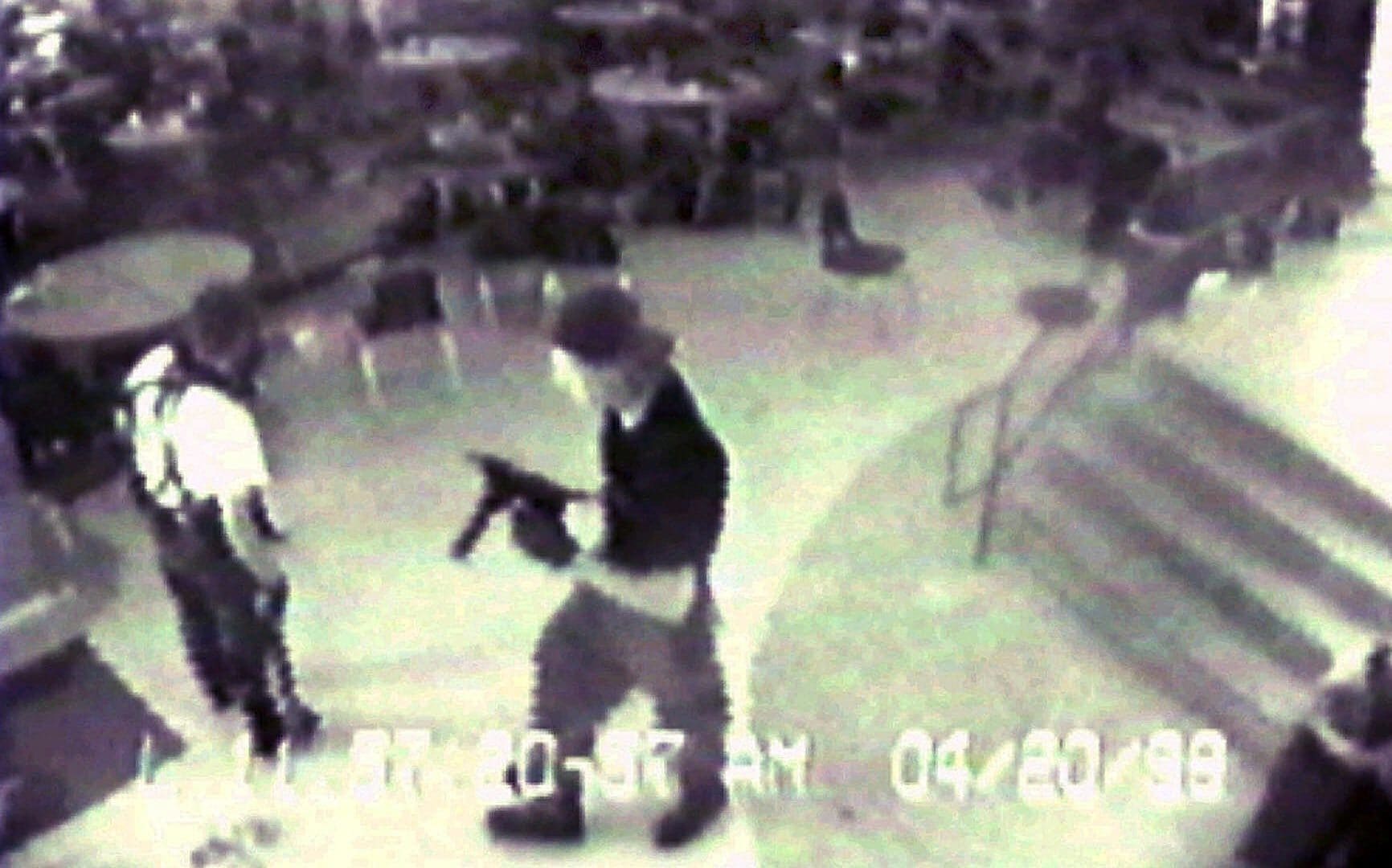
In the aftermath of an attack, the suspect is lionised in their group – a trend that can be traced back to the 1999 Columbine school shooting - AP/Anonymous
As students across France were protesting in the streets this month, a 14-year-old walked into a school near Marseille, took a hunting rifle out of his guitar case, and opened fire.
“Mum, there’s a killer in the school,” one panicked schoolgirl told her mother over the phone as the gunman sprayed bullets through the hallways, wounding two teachers.
To some who knew him in the town of Aubagne, set in the mountains of Bouches-du-Rhône, the boy was a loner who was bullied; others said he was disruptive but not violent.
But anti-terror prosecutors, having searched his social media accounts following the shooting on Oct 12, charged him with terror-related crimes, citing the suspect’s “probable adherence” to the tenets of the True Crime Community (TCC). This is the first terror investigation to be opened in France in connection with an attack that has been linked to the TCC, according to French media.
The boy admitted he had been influenced by the community, but denied committing the act in its name, the anti-terrorism prosecutor’s office stated; the suspect instead cited a desire for revenge for harassment he claimed to have endured from teachers and classmates.

Police officers conduct bag searches as students arrive at Lakanal middle school in Aubagne, three days after a student carried out a gun attack against his teachers - AFP/Thibaud Moritz
He was charged with attempted murder in connection with a terrorist undertaking, carrying and transporting weapons and ammunition without lawful justification, and terrorist criminal conspiracy to commit crimes against persons. He remains in pre-trial detention. The youth admitted the shooting, but denied he had intended to kill, Le Parisien reported.
Experts are growing increasingly concerned about groups such as the TCC, The Com, No Lives Matter (NLM), 764, and CVLT, which glorify gore and infamous mass shooters while giving advice and encouragement to those seeking to commit violent deeds.
Members of these groups use gaming platforms such as Roblox and Minecraft to replicate the locations of well-known mass shootings, as well as potential future targets such as mosques. Such posts breach both platforms’ community guidelines and are removed. Minecraft said it maintains a zero-tolerance policy towards violent content, while Roblox said it continually evolves its moderation policies to crack down on violent material.
Vulnerable children are also groomed within these groups by adults who encourage them to commit violent acts against themselves and against others. In August, a 27-year-old American named Kyle Spitze was sentenced to 77 years in prison for grooming children in nihilistic groups.
Spitze “was committed to bringing about the downfall of society through terrorism, specifically by targeting children and other vulnerable people and extorting them to engage in criminal sexual conduct, self-harm, and mass-casualty events”, said John A Eisenberg, the assistant US attorney general for national security.

Members of the TCC use platforms such as Roblox to create mock-ups of previous or planned attacks
While many take inspiration from far-Right and terrorist ideology, what links most members of these organisations is not a desire for societal change, but rather a misanthropic world-view. This has led experts to coin the phrase “nihilist violent extremism”.
The majority of members keep their gruesome fantasies online, but a growing number of children appear to be acting them out in their place of learning.
Shortly before the shooting in Aubagne, there was a spate of attacks in Poland across a three-day period, in which one woman was killed and others, including children, were injured. Jakub Z, 19, admitted offences including attempted murder, and is awaiting trial, prosecutors said, while Wiktor S, suspected of killing a caretaker and injuring two other staff members, was ordered to be held in a juvenile detention centre while he underwent psychiatric assessment.
One of the attacks was thwarted, but mass online hysteria predicting a “bloody Friday” of attacks on schools sent police into panic mode, and 117 people were arrested for making threats or showing up armed near their schools.
Donald Tusk, the Polish prime minister, blamed the online “glorification of violence” for the attacks, along with the “copycat phenomenon”.

Police officers detain a suspect in the town of Ostroleka, Poland, earlier this month following a knife attack at a vocational school - AFP/Handout
Since Sept 8 this year, there have been at least 13 school attacks across the globe that are believed to have been related to the TCC. These latest incidents took place in Turkey, the Philippines, Croatia, Slovakia, Italy, Mexico, the US, France, Poland and South Africa, but there have previously been many more.
“We’ve been monitoring a real uptick in this type of nihilistic violence – attacks that are linked to online communities and defined by a misanthropic world-view,” said Milo Comerford, the senior director of policy and research at the Institute for Strategic Dialogue.
Mr Comerford spends a lot of time trawling those websites, identifying potential attackers and notifying the authorities about credible threats. He said the community was now global, but there had been a notable increase in violent events in south-east Asia and Mexico.
In North Jakarta, Indonesia, a 17-year-old whom authorities said was obsessed with violent and extreme content allegedly bombed a high-school mosque last November. He wrote the names of well-known mass shooters and white supremacist slogans on a toy submachine gun he carried during the attack, police said. Researchers claimed that content featuring the hashtags #TCC and #TEECEECEE had appeared on his TikTok account on numerous occasions. He is in a safe house awaiting trial.
Densus 88, the Indonesian government’s counter-terrorism unit, last year linked 70 young people across 18 provinces to the TCC network, of whom 20 were preparing attacks, mainly on schools. The unit noted that the individuals lacked any clear ideology beyond an attraction to violence.

Emergency services attend Lakanal middle school after the gun attack on Oct 12 - AFP/Miguel Medina
Members appear to be searching for a sense of belonging. Many dress in the same outfits as their heroes, with whom they develop parasocial relationships. They trade ironic memes about attacks, and photographs of themselves wearing masks and helmets.
Many attacks are filmed, because the overarching desire of the attackers is to achieve notoriety and validation online.
In the immediate aftermath of an attack, the suspect is lionised in their group – a trend that can be traced back to the 1999 Columbine school shooting, whose perpetrators were seen as “figures of rupture in a shared mythology of violence”, according to the Combating Terrorism Center at West Point, the United States Military Academy.
A figure recently hailed in these communities is Timofey K, who last December, at the age of 15, allegedly launched a knife attack at a school in Russia while filming and sharing the incident online.
Russian media said he had worn a shirt bearing the name of the nihilist group No Lives Matter, and a helmet inscribed with the words “Beat the Jews, Save Russia” – a slogan attributed to Dylann Roof, an American mass shooter. It is also claimed that he sent a manifesto called “My Wrath” to a social media channel, and the clothing of far-Right mass murderers such as Brenton Tarrant. Timofey, too, is in custody awaiting trial.
In Italy in March, a 13-year-old student stabbed his teacher after posting a manifesto that he titled the “final solution”. He livestreamed the act and spoke of wearing a skull-mask – not for the far-Right associations, but because he liked the aesthetic. As he was under Italy’s age of criminal responsibility, the judge ordered that he be placed in a community for minors, prosecutors said.
After the attack online, users shared fan art of the boy, with some depicting him as a saint.
Kacper Rekawek, an analyst at the International Centre for Counter-Terrorism, told The Telegraph that some children become radicalised because of problems at home, bullying, or a sense of isolation. They are often already vulnerable, suffering from mental health issues such as anorexia or ADHD, and spending a lot of time online.
The EU says the number of incidents related to this ideology is rising, while last year, the UK Government reported an increase in “a fascination with extreme violence or mass-casualty attacks”.
Europol has warned of a surge in “online communities dedicated to extremely violent child abuse”.
Jesse van Rootselaar, who died in the shooting from a self-inflicted gunshot, killed nine people and injured 25. A 30-year-old US resident has been arrested and charged in connection with the attack, after authorities alleged he had been in repeated contact with Rootselaar, offering advice, sending money, and even agreeing to livestream a horrific event.

Jesse van Rootselaar, who killed nine people at a high school in Canada, complained of feeling addicted to the content despite knowing it was harmful - Reuters/United States Department of Justice
Dr Brad Bushman, a psychologist who studies the effects of violent content on children, told The Telegraph: “When people are exposed to violence, they become numb to it. They become desensitised. They think it’s no big deal.”
People’s heart rate, blood pressure and brain activity change after exposure, said Dr Bushman, and their behaviour changes too: “They’re less likely to help others.”
Studies have shown that exposure to violence in the media increases aggressive behaviour in people of all ages, especially children, said Dr Bushman, with realistic violence even more harmful than the fantasy type.
Most of the ecosystem is organic, but Mr Comerford said some countries could be trying to weaponise the nihilism and hopelessness seen in these communities.
“We shouldn’t be surprised that Russia and other state actors look to weaponise vulnerable communities. They look to polarise contentious topics, and these communities are relatively low-hanging fruit,” he said. “Our evidence points to known Kremlin operations that are providing real support to these online communities.”
One such Russian-speaking network, called the Alliance, is unusually sophisticated compared with the more organic platforms. It publishes instruction manuals and ideological materials in both English and Russian, as well as hosting a marketplace for trading in illegal goods and services.
The Institute for Strategic Dialogue, an independent research organisation analysing extremism, disinformation and online threats, says it has identified “numerous indicators of potential Russian state sponsorship that merit investigation”, and that Russian-speaking actors are introducing unusually experienced and well-resourced capabilities.
Furthermore, many of the photos shared within different networks feature the same indoor setting, which suggests that a significant portion of propaganda comes from a small number of Russians.
Another sign that some believe indicates potential Russian activity is the offering of financial incentives to proxy-style recruits. Ukraine’s security services alleged that Russian handlers had recruited two Ukrainian teenagers to carry out separate school attacks via another nihilist community known as Group A, led by a man in Dagestan.
Mr Rekawek said there were concerns that hostile nations were using these platforms to foment chaos abroad.
“There are people asking a legitimate question – that perhaps this stuff was actually orchestrated by the Russians,” he said. “Or that they might try to orchestrate things like that in the future, and come after our kids.”
A spokesman for Minecraft said: “Violent extremism has no place in Minecraft. We recognise that bad actors may seek to exploit online gaming communities and we take that threat seriously.
“We prohibit violent extremist content and take a multi-layered approach to safety that combines detection, moderation, enforcement, reporting, and parental controls for families.
“Terrorism and violent extremism are society-wide challenges that no single company can tackle alone, and we’ll continue to work with governments, external experts, and partners to strengthen safety across our industry.”
Roblox has been contacted for comment.
Try full access to The Telegraph free today. Unlock their award-winning website and essential news app, plus useful tools and expert guides for your money, health and holidays.
Source: Crime



0 Comments